
A fatal Houston ICE shooting that started with a mistaken traffic stop now raises hard questions about justice, accountability, and how far immigration agents can go when they say they feared a car was a weapon.
Story Snapshot
- ICE says Lorenzo Salgado Araujo used his van as a weapon and tried to run over an officer.
- The medical examiner has ruled his death a homicide, and agents had no body cameras.
- New video and witness accounts do not clearly back ICE’s most serious claims.
- Democrats and activists push for probes that could hamstring immigration enforcement nationwide.
What ICE Says Happened in the Houston Stop
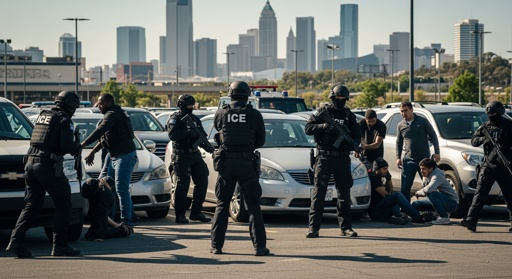
Federal immigration officers pulled over 52-year-old Mexican national Lorenzo Salgado Araujo in Houston after spotting a van that looked like one tied to another suspect they were tracking. Immigration and Customs Enforcement (ICE) says Araujo tried to flee, rammed an ICE vehicle, ignored repeated commands, and then tried to use his van to run over an officer, forcing the agent to fire in self-defense. Araujo was hit in the abdomen and later died from the gunshot wound, according to local reporting. The Federal Bureau of Investigation (FBI) in Houston is leading a probe into a possible assault on a federal officer, which shows officials are treating the vehicle-attack claim as serious and credible.
The Department of Homeland Security Office of Inspector General is also running its own review of the shooting. On paper, that gives the Trump administration and ICE a formal process to examine whether deadly force met the legal standard of an “imminent danger of death or serious physical injury,” which is written into ICE’s own use-of-force rules. Supporters of tough immigration enforcement point out that officers face real threats, including cars used as weapons, and argue they must be allowed to defend themselves when a suspect turns a vehicle into a battering ram.
Homicide Ruling, No Body Cameras, and Conflicting Evidence
While ICE frames the shooting as self-defense, the Harris County Medical Examiner has officially ruled Araujo’s death a homicide caused by a gunshot wound during the operation, not an accident. That ruling does not by itself prove murder, but it undercuts any effort to treat the shooting as a simple “justified use of force” without further review. At the same time, Homeland Security has confirmed the Houston immigration agents involved were not wearing body cameras, and their field office is still not equipped with them. That means there is no direct officer video to confirm or disprove the claim that Araujo rammed a vehicle or tried to run someone over.
Surveillance footage obtained by local media shows federal sport utility vehicles boxing in the white van, but the key moment ICE describes is murky rather than clear. The video does not plainly show Araujo using the van as a weapon, which leaves a gap between the agency’s strongest allegations and what the public can see for themselves. Araujo’s son has said on camera that his father was shot inside the van by agents in unmarked vehicles and that he could hear his father crying for help while bleeding out, a detail that raises more questions about how fast officers moved to render aid after the shot. So far, none of the passengers who were detained in the van have given sworn public statements, leaving a crucial piece of the timeline missing.
Democrats, Activists, and a Push to Reshape Federal Enforcement
Four Houston Democrats in Congress, including Representative Sylvia Garcia and Representative Al Green, have demanded an independent investigation and the full release of all video, body camera, dash camera, and warrant records tied to the operation. Their letter to Homeland Security Secretary Markwayne Mullin and ICE Director David Venturella presses for preservation of evidence and strongly questions ICE’s version of events, signaling a broader push from the left to rein in Trump-era immigration enforcement. Civil rights organizations have seized on the lack of body cameras and the homicide ruling to argue ICE is hiding the truth and manipulating the story, claims that, if accepted, could be used to attack the legitimacy of future enforcement actions.
Local officials in Texas say federal authorities have largely shut them out of the probe, which fuels concerns about federal overreach and transparency. Harris County’s district attorney has publicly asked anyone with video or witness accounts to come forward, showing local prosecutors are at least trying to build their own picture of what happened. Meanwhile, protests and social media campaigns have turned the Houston case into another rallying point against immigration crackdowns, echoing earlier controversies in Minneapolis and Los Angeles where federal agents also fired on people in vehicles. Each time, ICE insists the driver turned the car into a weapon, and each time, video and witness accounts trigger doubts, but rarely criminal charges against the officers.
Pattern of Vehicle Shootings and What It Means for Trump-Era Policy
This Houston incident fits a broader pattern of immigration agents opening fire at drivers while claiming they faced life-threatening danger from moving cars. An investigative report found 59 shootings by ICE officers between 2015 and 2021, with at least 24 people injured and many more killed, and a striking lack of criminal accountability for agents. Since Trump returned to the White House, similar shootings in Minneapolis left U.S. citizens Alex Pretti and Renee Good dead after federal agents said they feared being struck by their vehicles. In Good’s case, footage showed her turning away as shots were fired, and yet federal officials still defended the officer as following his training.
Legal experts note that the standard used to judge federal officers focuses on what seems “reasonable” to the officer at the time, not what an ordinary citizen might see later on video. That bar, combined with weak transparency, helps explain why agents almost never face charges even when official accounts clash with recordings. For conservatives, the stakes cut both ways. On one side, America needs strong border and interior enforcement and must protect officers from real threats, including weaponized vehicles and violent suspects. On the other, the same federal power, if unchecked, can erode due process, inflame local tensions, and hand the left a powerful narrative weapon to attack Trump’s entire immigration agenda.
Sources:
mediaite.com, texastribune.org, washingtonpost.com, x.com, facebook.com, cbsnews.com, instagram.com, pbs.org, click2houston.com, algreen.house.gov, youtube.com, khou.com, nbcnews.com